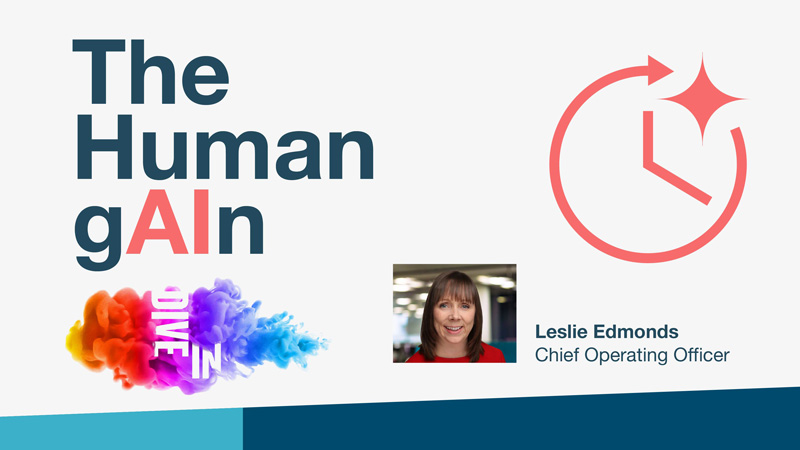
The Human gAIn: turning technological progress into human progress (Part 1)
September 10, 2026
By Leslie Edmonds, Chief Operating Officer, Asta
There is no shortage of discussion about what AI can do. The more interesting question for leaders is what it can enable people to do differently, and better.
That is why this year's Dive In Festival theme, The Human gAIn, resonates with me. AI has the potential to increase both the capacity and capability of an organisation, but those gains are only meaningful if they translate into better working lives, stronger teams and better outcomes for clients. Technology can accelerate performance; culture ultimately determines what organisations do with that opportunity.
Creating capacity – and deciding what to do with it
Much of the conversation around AI has understandably focused on productivity. Removing repetitive administrative tasks, processing information more quickly and making knowledge easier to access can all help organisations work more efficiently. But if the human gain simply becomes asking people to do more, faster, we will have missed much of the opportunity.
Reducing administrative burden should create more time for people to apply judgement, solve problems, collaborate and develop ideas. It can also give them quicker access to analysis, information and expertise that may previously have taken hours to source and digest. For me, the gain is not simply the time saved, but what people are able to do with that time.
There is another important dimension. Specialist knowledge has traditionally tended to sit with a relatively small number of experienced people. AI can make more of that knowledge accessible across an organisation, helping junior colleagues develop more quickly and contribute at a higher level, while allowing experienced professionals to spend more time coaching, mentoring and applying their judgement to more complex challenges.
This is particularly relevant at Asta because finding solutions for our clients is central to how we work. We have small, self-organising teams with the autonomy to bring their expertise together and solve client problems. Technology can give those teams greater capacity, but the value comes from enabling people to use that capacity well.
It also prompts us to think differently about operational excellence. Traditionally, the focus has been on doing things faster, more efficiently and at lower cost. In an AI-enabled organisation, I think we should broaden that definition to include creating more time for people to think, connect, innovate and serve clients better. That, to me, is a much more valuable measure of human gain.
Bringing people with you
Realising those benefits depends on how organisations introduce and use the technology. Giving people access to AI is not the same as enabling them to benefit from it, and this is where familiar principles of organisational change remain important.
At Asta, the ADKAR change management model has helped inform our approach. Its five elements – Awareness, Desire, Knowledge, Ability and Reinforcement – provide a useful framework for thinking about how change becomes established within an organisation.
People need to understand why change is happening and why it is relevant to them. They need the knowledge and skills to use new tools effectively, together with opportunities to experiment and build confidence. Successful new behaviours then need to be reinforced so that they become part of everyday working life.
For leaders, that means explaining the 'why', creating pull rather than simply pushing technology into an organisation, teaching people how to use it and giving them space to try things. It also means sharing and celebrating examples where colleagues have found better ways of working so that others can see the practical benefits for themselves.
We have been taking this approach at Asta through our Digital Innovators programme over the past two years and, more recently, through our Hackathon. Both have given colleagues opportunities to explore technology, test ideas and play an active part in shaping how we use it. If we want the adoption of AI to result in human gain, that involvement matters. Technology should elevate people's contribution, not diminish it.
The things technology cannot replace
As technology becomes more capable, it is equally important to be clear about what we do not want to lose. Trust, expertise, consistency, accountability, judgement, relationships and curiosity remain fundamental. AI may help us find answers more quickly, but people are still responsible for asking the right questions, interpreting the answers and deciding what to do next.
This is especially relevant in insurance because clients ultimately buy confidence. As a leading third-party managing agent in the Lloyd's market, we hear this in conversations with our own clients. One of the reasons new clients give for choosing Asta is that we are trusted and have a proven track record of supporting businesses to achieve their goals at different stages of their development.
Trust is built over time through expertise, consistency and human connection. AI can strengthen the first two by giving people better access to information, supporting analysis and helping organisations deliver more consistently. Connection and empathy are different. They depend on relationships, understanding individual circumstances and knowing when experience and judgement need to be applied.
Insurance exists because people and businesses want confidence that someone will be there when things go wrong. Following a fire, flood, cyber incident or another significant loss, they need decisions to be fair, transparent and accountable. They also need to know that when circumstances are complex or unusual, there is still someone applying experience, empathy and judgement.
Technology may help us make decisions more quickly and with better information. The human gain comes when it helps our people make those decisions better and gives them more time to understand and support the people affected by them.
What will distinguish the organisations that succeed?
I don't think the most successful insurance businesses will necessarily be those with the most advanced AI. Access to increasingly powerful technology will become widespread. The more meaningful distinction will be how organisations use it and whether it strengthens the qualities on which relationships with clients and colleagues depend.
We talk frequently about technology changing work, but spend less time considering how work should change for people. If AI removes administrative friction and makes knowledge more accessible, the opportunity is not simply to increase output. It is to give people more scope to contribute, develop their expertise, work together and focus on the areas where they add most value.
This is also why the wider conversations promoted by Dive In around culture, inclusion, belonging and accessibility matter. As AI becomes more deeply embedded in our organisations, we need different voices and perspectives involved in deciding how it is used and what we want it to achieve. The way we implement technology will shape people's experience of work, so it cannot be treated as a technology discussion alone.
For me, that is the challenge – and the opportunity – behind The Human gAIn. AI can create capacity and capability on a scale we have not had before. The organisations that make the most of it will be those that turn those advantages into something more human: better opportunities for their people, stronger cultures, deeper relationships and greater trust with the clients they serve.